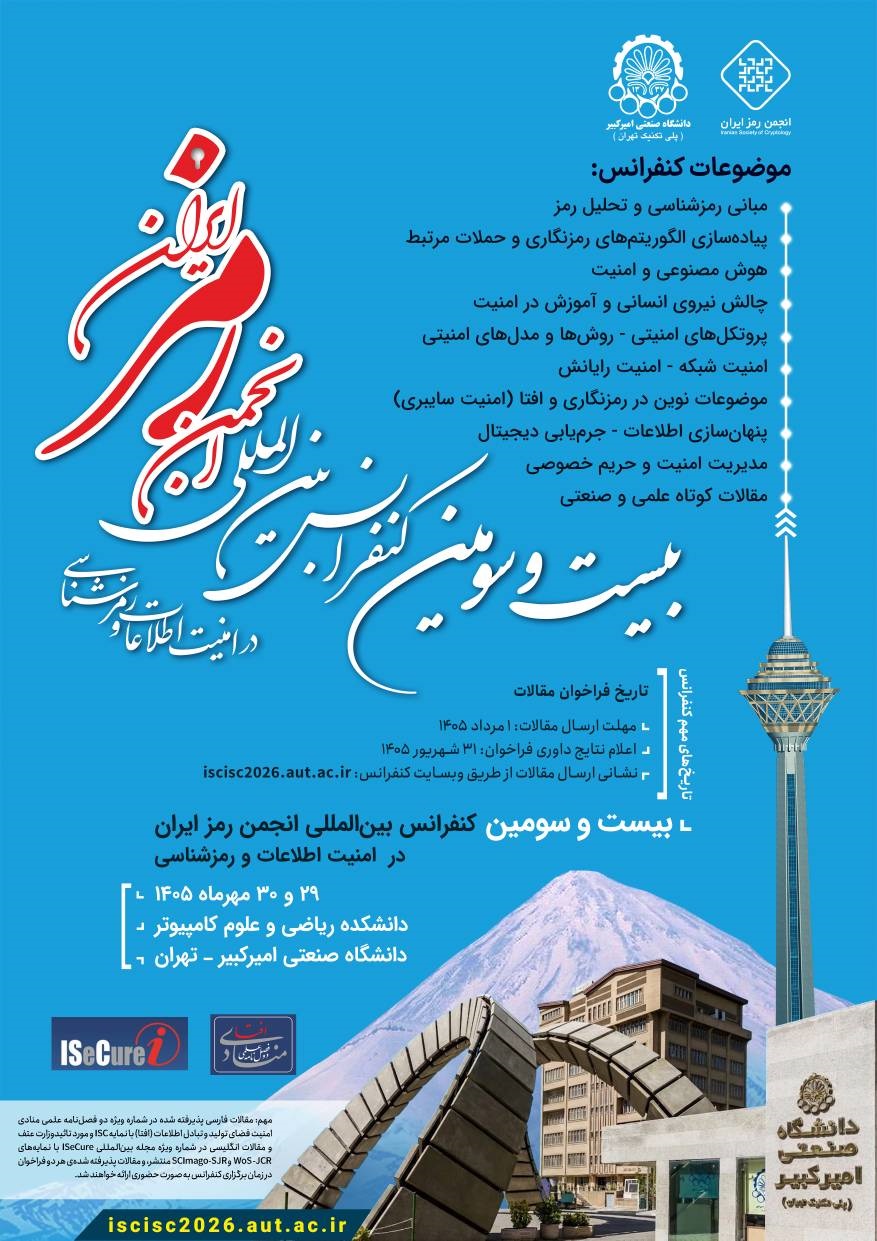
 The 23rd International Conference of the Iranian Society of Cryptology was held at Amirkabir University of Technology (AUT) for the first time. Dr. Mahmoud Salmasizadeh, President of the Iranian Society of Cryptology, highlighted the academic standing of AUT’s Faculty of Mathematics and Computer Science, particularly in the fundamental aspects of cryptology, and identified “Security and Artificial Intelligence” as the main focus of this year’s conference papers. He noted that the conference addressed both the impact of artificial intelligence on security and cyberattacks and the use of artificial intelligence to counter and detect attacks. He also highlighted the participation of researchers, industry professionals, and individuals operating businesses in the field of Information Production and Exchange Security (AFTA) or cybersecurity. The “Employment Café” program, held alongside the Society’s conferences, also provides an opportunity for cybersecurity companies from the public and private sectors to introduce job opportunities, connect with students and specialists, and recruit new talent.
Dr. Salmasizadeh identified the shortage of specialized human resources and the lack of an economic ecosystem for cybersecurity technology as among the country’s major challenges. He emphasized that, alongside developing human resources, an economic market for the sector must also be established. He pointed to the Society’s efforts to bridge the gap between academia and industry through close cooperation with cybersecurity organizations across the country and by providing scientific, technological, and strategic expertise to industry stakeholders. He also cited the development and approval of the charter of the Headquarters for the Development of AFTA Science and Technology over the past two years as one of the Society’s major achievements, noting that the headquarters is now actively operating.
Dr. Salmasizadeh further referred to the Society’s nearly nine-year effort to establish stronger links between cybersecurity and the country’s school sector, as well as recent efforts to launch a national student cybersecurity olympiad. He expressed hope that, with the cooperation of the Young Researchers Club, the Ministry of Education, and other relevant institutions, the olympiad could be held in the country, enabling talented students to compete in cybersecurity alongside other national student olympiads.
|